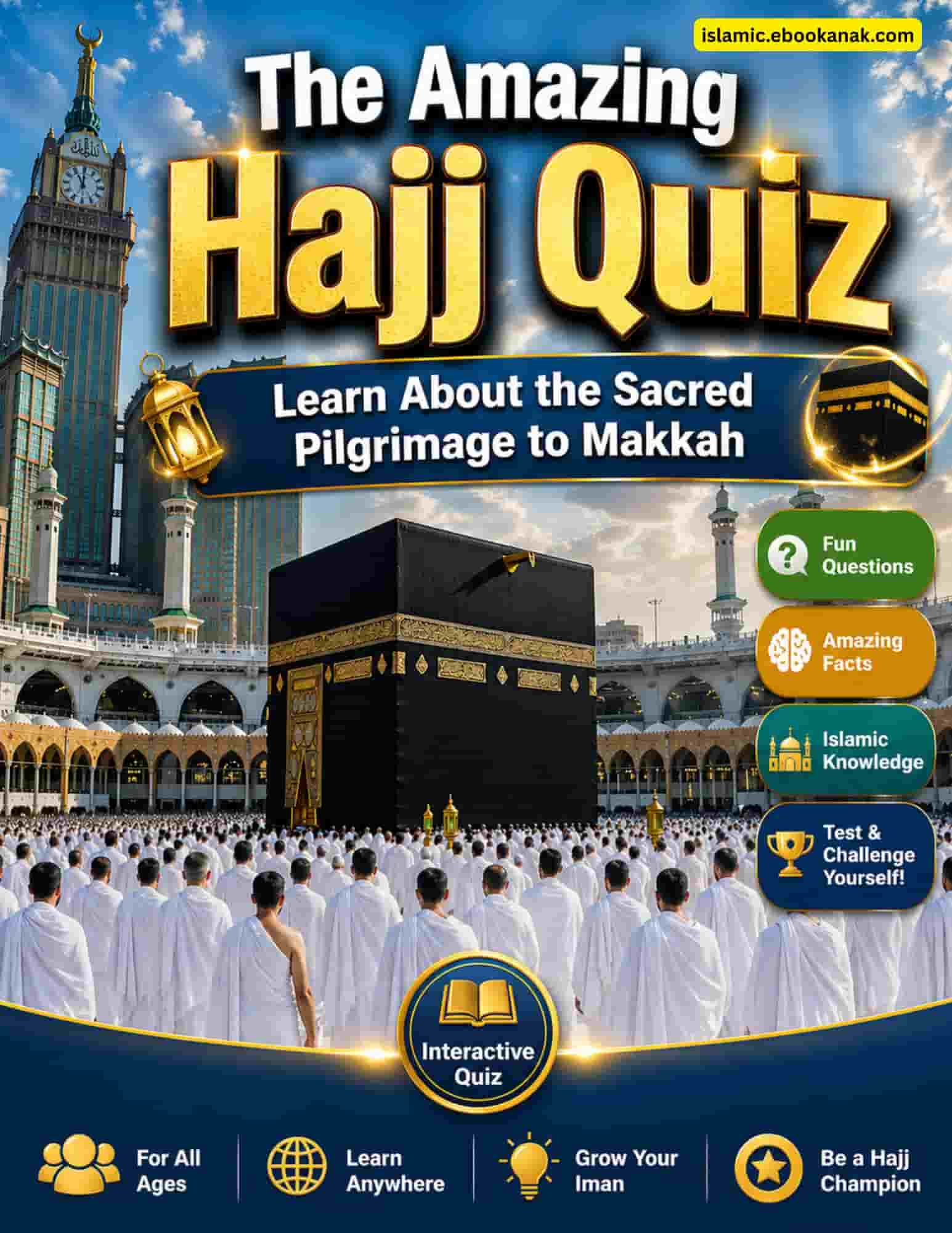
Instructions: Choose the best answer (A, B, C, or D) for each question. No calculators or phones are needed—just your brain and your love for Allah! 📚✨
1. Hajj is one of the Five Pillars of Islam. How many times must a Muslim perform it if they are physically and financially able?
A) Once a year
B) Five times in their lifetime
C) Once in their lifetime
D) Whenever they visit Saudi Arabia
2. The Quran tells us to proclaim Hajj to all of humanity. Which Surah contains the famous verse: “And proclaim to the people the Hajj [pilgrimage]; they will come to you on foot and on every lean camel…”?
A) Surah Al-Fatihah
B) Surah Al-Baqarah
C) Surah Al-Ikhlas
D) Surah Al-Hajj
3. Before entering Makkah for Hajj, a Muslim enters a special state of purity and intention called Ihram. For men, this clothing consists of:
A) A three-piece suit
B) Two white, seamless sheets
C) A green turban and a sword
D) Any new clothes from the mall
4. What is the spiritual meaning of Hajj?
A) A vacation to see the desert
B) A business trip to sell goods
C) A physical and financial act of worship to obey Allah
D) A mandatory visit to a museum
5. While in the state of Ihram, there are strict rules to follow. Which of the following is FORBIDDEN (Haram) for a pilgrim?
A) Helping an old person
B) Cutting fingernails or hair
C) Drinking Zamzam water
D) Making Dhikr (remembrance of Allah)
6. When starting Hajj or Umrah, Muslims recite the Talbiyah. What is the very first word of this powerful chant?
A) Alhamdulillah
B) Subhanallah
C) Labbaik
D) Astaghfirullah
7. The first thing a pilgrim does when reaching the Grand Mosque (Masjid al-Haram) is to perform Tawaf. What is Tawaf?
A) Running between two hills
B) Walking around the Kaaba seven times
C) Drinking water seven times
D) Praying 100 rakats
8. What is the name of the sacred black stone set into the corner of the Kaaba, which the Prophet Muhammad ﷺ kissed during Tawaf?
A) Al-Hajar al-Aswad
B) Maqam Ibrahim
C) Al-Rukn al-Yamani
D) Jabal al-Noor
9. After Tawaf, pilgrims pray two rakats behind a famous spot. What is that spot called?
A) The Zamzam Well
B) The Door of the Kaaba
C) Maqam Ibrahim (Station of Abraham)
D) The pulpit (Minbar)
10. The ritual of Sa’i involves walking back and forth between the hills of Safa and Marwah. Whose desperate search for water does this action commemorate?
A) Prophet Musa (Moses) searching for the Red Sea
B) Hajar (Hagar), the wife of Prophet Ibrahim (Abraham)
C) Prophet Muhammad ﷺ searching for his tribe
D) Queen Sheba looking for King Solomon
11. On the 8th day of Dhul-Hijjah, pilgrims leave Makkah to a large tent city. What is this location called?
A) Arafat
B) Muzdalifah
C) Mina
D) Madinah
12. The most important day of Hajj is the 9th of Dhul-Hijjah. Pilgrims gather at a vast plain to stand in prayer and supplication. This standing is called Wuquf. Where does it take place?
A) The seashore of Jeddah
B) The Plain of Arafat
C) The cave of Hira
D) The mosque of Quba
13. The Prophet Muhammad ﷺ said: “Hajj is ‘Arafah.” This means that if someone misses the standing at Arafat, they have:
A) Missed the Hajj entirely
B) Just missed a small Sunnah
C) Only need to pay a fine
D) Can repeat Hajj next year automatically
14. After sunset at Arafat, pilgrims move to an open area called Muzdalifah. What is the primary activity there?
A) Swimming in a pool
B) Collecting small pebbles for the “Stoning of the Devil”
C) Shopping for souvenirs
D) Cutting hair immediately
15. In Mina, pilgrims throw small stones at three pillars. Who do these pillars represent?
A) The Pharaoh of Egypt
B) The tribe of Quraysh
C) Shaytan (Satan), who tried to stop Prophet Ibrahim from obeying Allah
D) Famous kings of the past
16. After the stoning, pilgrims sacrifice an animal (sheep, goat, or cow). This act of sacrifice commemorates the great obedience of:
A) Prophet Yusuf (Joseph)
B) Prophet Ibrahim (Abraham) and his son Ismail
C) Prophet Nuh (Noah)
D) Prophet Musa (Moses)
17. What does Eid al-Adha literally mean?
A) “Festival of the End”
B) “Festival of Lights”
C) “Festival of the Sacrifice”
D) “Festival of the New Moon”
18. After the sacrifice, men usually shave or trim their heads. This act is called Halq or Taqsir. What should a woman do to exit her Ihram?
A) She must shave her head too
B) She must dye her hair
C) She may cut her hair by the length of a fingertip
D) She does nothing
19. What is the difference between Hajj and Umrah?
A) Hajj is for men only, Umrah is for women only
B) Hajj is optional, Umrah is mandatory
C) Hajj has specific dates (Dhul-Hijjah) and more rituals; Umrah can be done any time
D) There is no difference
20. If a person is too old or sick to ever perform Hajj themselves, what does Islam say they should do?
A) They are sinful forever
B) They can pay someone (Hajj Badal) to perform Hajj on their behalf
C) They should just watch videos online
D) Nothing, because Islam ignores the elderly
21. Which companion of the Prophet ﷺ was known for carrying the banner of the army and narrating many ahadith about the rituals of Hajj in detail?
A) Abu Bakr As-Siddiq
B) Umar ibn Al-Khattab
C) Jabir ibn Abdillah
D) Bilal ibn Rabah
22. While performing Tawaf, there is a corner of the Kaaba that is considered highly virtuous to touch (but not kiss) called the Yemeni Corner. What is its Arabic name?
A) Al-Rukn al-Shami
B) Al-Rukn al-Iraqi
C) Al-Rukn al-Yamani
D) Al-Rukn al-Asghar
23. In the Quran, Allah mentions that pilgrims may seek the bounty of their Lord during Hajj. What does this refer to?
A) Begging for money
B) Engaging in trade and business during Hajj
C) Sleeping all day
D) Ignoring the poor
24. After completing Hajj and returning home, a pilgrim is given a title of respect in many Muslim cultures. What is that title?
A) Mawlana
B) Alim
C) Hajji (for men) / Hajjah (for women)
D) Qari
25. What is the reward for an accepted Hajj (Hajj Mabrur)?
A) The pilgrim becomes a prophet
B) The pilgrim gets 10 million dollars
C) The pilgrim is guaranteed a house in Makkah
D) The pilgrim returns home sinless, like a newborn baby
📝 ANSWER KEY & EXPLANATIONS
1. C) Once in their lifetime
Source: Qur’an (3:97) & Sahih Bukhari.
Explanation: Allah says, “…it is for Allah from the people a pilgrimage to the House – for whoever is able to find a way.” The Prophet ﷺ said: “Hajj is once, and whoever does more, it is voluntary.” Doing it once fulfills the obligation .
2. D) Surah Al-Hajj
Source: Qur’an (22:27).
Explanation: The 22nd chapter of the Quran is literally named “The Pilgrimage” (Al-Hajj). The verse commands Prophet Ibrahim to call the people to Hajj.
3. B) Two white, seamless sheets
Source: Fiqh (Classical Jurisprudence).
Explanation: Men wear the Izar (lower garment) and Rida (upper garment). This clothing strips away status, showing equality—everyone looks the same whether king or pauper.
4. C) A physical and financial act of worship to obey Allah
Source: Quran 2:196 .
Explanation: Hajj is not leisure. Allah says: “And complete the Hajj and Umrah for Allah.” It is an act of Taqwa (piety) and devotion.
5. B) Cutting fingernails or hair
Source: Quran 2:196 & Hadith.
Explanation: In Ihram, the pilgrim cannot cut hair, nails, use perfume, hunt, or engage in marital relations. These restrictions focus the mind entirely on Allah .
6. C) Labbaik
Source: Sahih Muslim.
Explanation: “Labbaik Allahumma Labbaik” means “Here I am, O Allah, here I am.” It is the chant of a pilgrim responding to Allah’s call.
7. B) Walking around the Kaaba seven times
Source: Quran & Sunnah.
Explanation: Tawaf consists of seven circuits (Ashwat) around the Kaaba in a counter-clockwise direction. We emulate the angels circling the Throne of Allah.
8. A) Al-Hajar al-Aswad
Source: Sahih Bukhari.
Explanation: The Black Stone. Umar ibn Al-Khattab famously kissed it and said, “I know you are a stone. You cannot harm nor benefit me. If I had not seen the Prophet kiss you, I would not have kissed you.”
9. C) Maqam Ibrahim (Station of Abraham)
Source: Quran 2:125.
Explanation: This is the stone upon which Prophet Ibrahim stood while building the Kaaba; it contains his famous footprints. Allah commands us to take it as a place of prayer.
10. B) Hajar (Hagar), the wife of Prophet Ibrahim (Abraham)
Source: Sahih Bukhari.
Explanation: Hajar ran seven times between Safa and Marwah looking for water for her crying baby, Ismail. Angel Jibreel struck the ground, and the Zamzam well burst forth .
11. C) Mina
Source: Hajj Rituals.
Explanation: Mina is known as the “City of Tents.” It is a massive valley where pilgrims spend the 8th and 12th/13th nights of Dhul-Hijjah.
12. B) The Plain of Arafat
Source: Sahih Muslim .
Explanation: Wuquf (standing) at Arafat is the peak of Hajj. Pilgrims stand from noon until sunset, making Dua and seeking forgiveness. Jabl al-Rahmah (Mount of Mercy) is located here.
13. A) Missed the Hajj entirely
Source: Hadith (Sahih).
Explanation: The Prophet ﷺ said: “Hajj is ‘Arafah. Whoever catches the night of ‘Arafah before the dawn of the 10th has caught Hajj.” If you miss the day at Arafat, you missed Hajj.
14. B) Collecting small pebbles for the “Stoning of the Devil”
Source: Sahih Muslim.
Explanation: In Muzdalifah, pilgrims pray Maghrib and Isha together, rest, and collect 49 or 70 small pebbles to throw at the pillars (Jamarat) in Mina the next day .
15. C) Shaytan (Satan), who tried to stop Prophet Ibrahim from obeying Allah
Source: Tafsir and Sirah.
Explanation: When Ibrahim was going to sacrifice Ismail, Shaytan appeared to tempt him. Ibrahim threw stones at him. We re-enact this rejection of evil.
16. B) Prophet Ibrahim (Abraham) and his son Ismail
Source: Quran (37:102-107).
Explanation: Allah replaced Ismail with a great ram just as Ibrahim put the knife down. The sacrifice commemorates this ultimate act of submission to Allah.
17. C) “Festival of the Sacrifice”
Source: Arabic Language.
Explanation: Eid al-Adha combines Eid (festival) and Adha (sacrifice). It is the celebration of the completion of Hajj and the global act of Qurbani.
18. C) She may cut her hair by the length of a fingertip
Source: Fiqh (Hanbali/Shafi’i).
Explanation: Women do not shave their heads. They gather their hair and cut a small portion (about an inch) from the ends to exit the state of Ihram.
19. C) Hajj has specific dates (Dhul-Hijjah) and more rituals; Umrah can be done any time
Source: Islamweb .
Explanation: Hajj has a fixed time (8th-13th of Dhul-Hijjah) and includes Arafat & Muzdalifah. Umrah is a “lesser pilgrimage” and can be done anytime, involving only Ihram, Tawaf, Sa’i, and Halq.
20. B) They can pay someone (Hajj Badal) to perform Hajj on their behalf
Source: Sunan an-Nasai (Hadith 2621) .
Explanation: A man asked the Prophet ﷺ about his elderly father who couldn’t ride a camel. The Prophet ﷺ replied: “Perform Hajj on behalf of your father and perform Umrah.”
21. C) Jabir ibn Abdillah
Source: Sahih Muslim.
Explanation: The detailed description of the Prophet’s Farewell Hajj (Hajjatul Wada) comes from the mouth of Jabir ibn Abdillah (RA). His narration is the textbook of Hajj rituals.
22. C) Al-Rukn al-Yamani
Source: Sahih Hadith.
Explanation: The Rukn al-Yamani (the corner facing Yemen) is highly virtuous. The Prophet ﷺ used to touch it when possible, and it is said that duas are accepted there.
23. B) Engaging in trade and business during Hajj
Source: Quran 2:198 .
Explanation: Allah says: “There is no blame upon you for seeking bounty from your Lord [during Hajj].” This permits Halal business and trade, as the Quraysh were worried that commerce during Hajj was not allowed.
24. C) Hajji (for men) / Hajjah (for women)
Source: Common Islamic Culture.
Explanation: While not a formal religious requirement by the Sunnah, it is a respected title in Muslim societies (including Egyptian and Levantine cultures) honoring the one who has completed the pilgrimage to Makkah.
25. D) The pilgrim returns home sinless, like a newborn baby
Source: Sahih Bukhari & Sahih Muslim.
Explanation: The Prophet ﷺ said: “Whoever performs Hajj for the sake of Allah and does not commit any evil or sin, will return (free from sin) as the day his mother gave birth to him.”