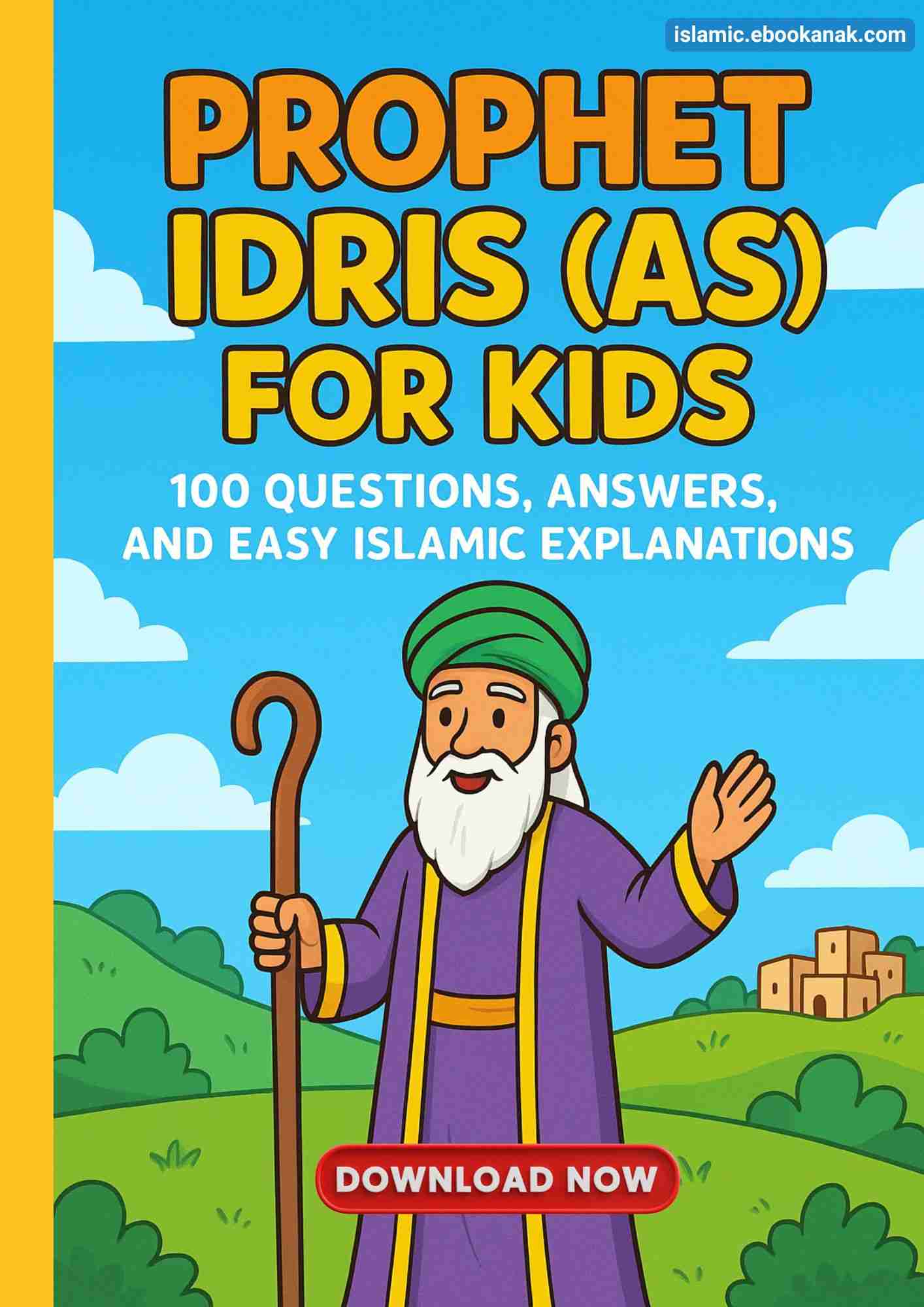


Prophet Idris (AS) for Kids — 25 Multiple-Choice Questions
Interactive worksheet with instant answer reveal and clear explanations. Designed for children and classroom use. Click any question to reveal the correct answer and the explanation.
Prophet Idris (AS) for Kids: 100 Questions, Answers, and Easy Islamic Explanations
1.
Q: Who was Prophet Idris (AS)?
A: He was a very wise and truthful Prophet who came after Prophet Adam (AS) and before Prophet Nuh (AS).
Discussion: The Quran tells us he was a man of truth and a Prophet, and he is mentioned among the patient and righteous.
Source: Quran, Surah Maryam (19):56-57, Surah Al-Anbiya (21):85.
2.
Q: What does the name “Idris” mean?
A: It comes from the Arabic root “darasa,” which means “to study” or “to learn.” He was given this name because he was always studying and learning from the scriptures.
Discussion: His name itself teaches us about the importance of seeking knowledge.
Source: Tafsir Ibn Kathir, Stories of the Prophets.
3.
Q: What was Prophet Idris known for?
A: He was known for his immense wisdom, his dedication to writing, and his deep knowledge.
Discussion: He is often described as the first person to write with a pen and to study astronomy and mathematics.
Source: Stories of the Prophets, Ibn Kathir.
4.
Q: Was Prophet Idris mentioned in the Quran?
A: Yes, he is mentioned by name twice in the Quran.
Discussion: Allah praises him in Surah Maryam and includes him among the patient ones in Surah Al-Anbiya.
Source: Quran, Surah Maryam (19):56-57, Surah Al-Anbiya (21):85.
5.
Q: What did Allah say about Idris in the Quran?
A: “And mention in the Book [the story of] Idris. Indeed, he was a man of truth and a prophet. And We raised him to a high station.” (Maryam:56-57)
Discussion: This “high station” is understood by scholars to mean he was raised in status in the Hereafter and some believe he was raised to the heavens physically.
Source: Quran, Surah Maryam (19):56-57.
6.
Q: What was his main message to his people?
A: Just like all prophets, his main message was to worship Allah alone and to live a righteous and fair life.
Discussion: He called his people away from the corruption and idol worship they had fallen into after the time of Prophet Adam (AS) and Shayth (AS).
Source: Core message of all prophets derived from Islamic creed.
7.
Q: What special skill is Prophet Idris famous for?
A: He is famous for being the first person to learn how to write with a pen.
Discussion: This was a huge step for humanity, as writing allows knowledge to be saved and passed on to future generations.
Source: Stories of the Prophets, Ibn Kathir (from Wahb ibn Munabbih).
8.
Q: What other sciences did he know?
A: He had knowledge of astronomy (the study of stars and planets), mathematics, and the science of time.
Discussion: He used his knowledge of the stars and seasons to help people in their daily lives, like farming and telling time.
Source: Stories of the Prophets, Ibn Kathir.
9.
Q: Did Prophet Idris receive a holy book?
A: It is reported that he received 30 scrolls (Sahifah) of revelation from Allah.
Discussion: These scrolls contained guidance and wisdom for his people to follow.
Source: Musnad Ahmad, Hadith from Abu Dharr.
10.
Q: How did Prophet Idris use his knowledge of writing?
A: He wrote down the revelations and his own wisdom so that people could read them and learn, even when he wasn’t there.
Discussion: By writing things down, he made sure the message of Allah would not be forgotten or changed easily.
Source: Logical application based on his known skills.
11.
Q: Why is writing so important?
A: Writing preserves knowledge. Without it, every generation would have to start learning everything from the beginning.
Discussion: Think about how we learn from books today—that tradition started with people like Prophet Idris!
Source: Reflection on the importance of literacy.
12.
Q: How did people learn before writing was invented?
A: They had to remember everything and pass it on by speaking to each other (oral tradition).
Discussion: This meant that stories and knowledge could change or be forgotten over time.
Source: Historical understanding.
13.
Q: What is Prophet Idris’s title?
A: He is often called “The Wise One” because of the great knowledge and understanding that Allah gave him.
Discussion: True wisdom is using knowledge in the best way to please Allah and help people.
Source: Derived from his description in Islamic sources.
14.
Q: Was Prophet Idris known for his patience?
A: Yes, the Quran lists him among the prophets who were extremely patient.
Discussion: “And [remember] Isma’il, Idris, and Dhul-Kifl—all were of the patient.” (Al-Anbiya 21:85)
Source: Quran, Surah Al-Anbiya (21):85.
15.
Q: What did he need to be patient about?
A: He was patient in teaching his people, who were often stubborn and did not want to listen to his message.
Discussion: Teaching others about truth requires a lot of patience and kindness.
Source: Derived from the context of prophethood.
16.
Q: What is a famous story about Prophet Idris and the Angel of Death?
A: It is narrated that the Angel of Death visited him in human form. Prophet Idris, curious about death, asked the angel to show him how his soul would be taken. The angel did so with Allah’s permission, and then Allah returned Idris to life.
Discussion: This story, found in classical commentaries, shows his deep curiosity about Allah’s creation and power.
Source: Tafsir Al-Qurtubi, Tafsir Ibn Kathir (based on Isra’iliyyat accounts, used for lessons, not for establishing law).
17.
Q: What did Prophet Idris ask to see after that?
A: The story continues that he asked to see Hellfire. When he saw it, he was so scared he fainted. After he recovered, he asked to see Paradise.
Discussion: Seeing Hellfire filled him with fear of Allah’s punishment, and seeing Paradise filled him with hope for Allah’s reward.
Source: Tafsir Ibn Kathir.
18.
Q: What happened when Prophet Idris saw Paradise?
A: He loved it so much that he asked the angel to let him enter it. By the command of Allah, he entered Paradise and remained there.
Discussion: This is how many scholars interpret the Quranic verse “And We raised him to a high station.” They believe he entered Paradise without tasting a second death.
Source: Tafsir Ibn Kathir, Al-Bidayah wan-Nihayah.
19.
Q: So, did Prophet Idris die like other people?
A: According to this well-known interpretation, he was taken to Paradise alive. However, Allah knows best the exact reality.
Discussion: This is a unique honor given to him and to Prophet Isa (Jesus), who was also raised to the heavens alive.
Source: Tafsir Ibn Kathir.
20.
Q: Where did Prophet Idris live?
A: Some historical sources say he lived and preached in Mesopotamia (modern-day Iraq).
Discussion: This was one of the earliest cradles of human civilization.
Source: Historical accounts in classical Islamic sources.
21.
Q: What can we learn from Prophet Idris’s love for learning?
A: We learn that seeking knowledge is a very holy and important act in Islam. It brings us closer to understanding Allah’s creation.
Discussion: The first word revealed in the Quran was “Iqra” which means “Read!” This shows how important learning is.
Source: Reflection on Quran, Surah Al-‘Alaq (96):1.
22.
Q: How can we be like Prophet Idris today?
A: By being curious, reading books, asking questions, and studying both religious and worldly sciences (like math and science) to become better Muslims and useful people.
Discussion: A Muslim should strive to be knowledgeable in all aspects of life.
Source: Derived from the Islamic ethic of seeking knowledge.
23.
Q: What did Prophet Idris teach about hard work?
A: He taught that people should work hard and learn skills to make a living, instead of being lazy.
Discussion: He himself was a tailor—he knew how to sew clothes!
Source: Stories of the Prophets, Ibn Kathir.
24.
Q: Prophet Idris was a tailor? What does that teach us?
A: It teaches us that having a skill and working with your hands is honorable. Even prophets had professions.
Discussion: There is no shame in doing any honest job.
Source: Stories of the Prophets, Ibn Kathir.
25.
Q: How did he combine his job with his mission as a prophet?
A: While he was sewing clothes for people, he would also talk to them about Allah and give them wise advice.
Discussion: He used every opportunity, even his work, to do good and call people to Allah.
Source: Reflection on his character.
26.
Q: What is the main lesson from his story about using our time?
A: We should use our time wisely, in learning, working, and worshipping Allah, not in useless activities.
Discussion: Time is a precious gift from Allah that we will be asked about on the Day of Judgment.
Source: Islamic principle based on Hadith.
27.
Q: Was Prophet Idris strong in his worship?
A: Yes, it is reported that he was so devoted that he would fast every other day.
Discussion: This shows his great love for obeying Allah and controlling his desires.
Source: Stories of the Prophets, Ibn Kathir.
28.
Q: What does his dedication to worship teach us?
A: It teaches us that while we live in this world, our ultimate goal is to please Allah through our actions, including our prayers and fasting.
Discussion: Balancing our worldly life with our spiritual life is key to being a good Muslim.
Source: Lesson from his example.
29.
Q: How did people react to his message at first?
A: Like many prophets, only a few people believed in him at the beginning. Many others rejected his call.
Discussion: This is why he is mentioned among the patient prophets. He never gave up, even when people made fun of him.
Source: Derived from the pattern of prophethood in the Quran.
30.
Q: What did the disbelievers say to him?
A: They probably said things like, “You’re just a man like us! Why should we listen to you?” and “Our fathers didn’t worship this way, so we won’t either.”
Discussion: These are the same things disbelievers said to other prophets. People often dislike change.
Source: Common themes in Quranic stories of the prophets.
31.
Q: How did Prophet Idris respond to their rejection?
A: With patience and wisdom. He continued to explain the truth clearly and kindly.
Discussion: He didn’t get angry and shout. He used knowledge and good manners to convince people.
Source: Implied from his character as a wise prophet.
32.
Q: What is a “man of truth” (Siddiq)?
A: It means someone who is always honest, whose heart, words, and actions all match. They believe in the truth and live by it.
Discussion: This is one of the highest titles a person can have in Islam.
Source: Explanation of the term “Siddiq” from Islamic scholarship.
33.
Q: Why is being truthful so important?
A: Because trust is the foundation of a good society. If people lie, families and communities fall apart.
Discussion: The Prophet Muhammad (PBUH) said, “Truthfulness leads to righteousness, and righteousness leads to Paradise.”
Source: Sahih al-Bukhari.
34.
Q: Did Prophet Idris perform any miracles?
A. The Quran does not mention specific miracles for him, unlike the staff of Musa or the healing of Isa. His wisdom and knowledge were among his greatest signs.
Discussion: Sometimes, the miracle is the message itself and the incredible character of the prophet.
Source: Observation from the Quranic narrative.
35.
Q: What can we learn from the way he taught people?
A: We learn that the best way to teach is with kindness, patience, and by setting a good example yourself.
Discussion: People are more likely to listen to you if they see that you practice what you preach.
Source: Lesson from his prophetic methodology.
36.
Q: How old was Prophet Idris when he was taken to Paradise?
A: The Quran and authentic hadith do not specify his age. Only Allah knows.
Discussion: A person’s age is not what’s important; it’s the good deeds they do in their lifetime that matter.
Source: Islamic principle.
37.
Q: Is Prophet Idris the same person as the Egyptian god “Thoth” or the Greek “Hermes”?
A: No, he is not. Some ancient cultures heard stories about a very wise man and made up their own gods based on him, but Prophet Idris was a human prophet who worshipped Allah alone.
Discussion: Muslims believe he was a real prophet, not a myth or a god.
Source: Islamic Aqeedah (Creed).
38.
Q: Where is Prophet Idris now?
A. According to the strongest Islamic opinion, he is alive in the heavens, just like Prophet Isa (Jesus).
Discussion: The Prophet Muhammad (PBUH) met him on the night of Al-Isra’ and Mi’raj during his journey through the heavens.
Source: Sahih al-Bukhari.
39.
Q: What did Prophet Muhammad (PBUH) see when he met Idris in the heavens?
A: He greeted him as a brother and a prophet. Idris welcomed him and said good things about him.
Discussion: This shows the respect and love all the prophets have for each other.
Source: Sahih al-Bukhari.
40.
Q: In which heaven did Prophet Muhammad (PBUH) meet Idris?
A: He met him in the Fourth Heaven.
Discussion: Each heaven has different residents, and Idris was given a high place in the heavens.
Source: Sahih al-Bukhari.
41.
Q: What does his story teach us about curiosity?
A: It teaches us that it’s good to be curious about the world and about Allah’s creation, as long as our curiosity leads us to learn more about Allah, not to disobey Him.
Discussion: Asking “how” and “why” about the universe can strengthen our faith.
Source: Lesson from his character.
42.
Q: How did Prophet Idris show gratitude to Allah for his knowledge?
A: By using it to help people and to guide them to the truth, not to become proud or rich.
Discussion: The best way to thank Allah for a blessing is to use it in a way that pleases Him.
Source: Reflection on the proper use of knowledge.
43.
Q: What would happen if Prophet Idris had kept his knowledge to himself?
A: It would have been a waste. Knowledge is like a light; it’s meant to be shared so that everyone can see.
Discussion: Sharing knowledge is a form of charity (Sadaqah) in Islam.
Source: Hadith, Sunan Ibn Majah.
44.
Q: Did Prophet Idris have a family?
A: The Quran and Hadith don’t give details, but as a prophet, he most likely had a wife and children to continue a righteous family line.
Discussion: Prophets were examples of how to have good family lives.
Source: Logical assumption based on the lives of other prophets.
45.
Q: What is the biggest difference between the knowledge of Prophet Idris and the knowledge of a scientist today?
A: Prophet Idris’s knowledge was based on revelation from Allah and was always connected to faith. A scientist’s knowledge today is based on research and experiment and can sometimes forget about Allah.
Discussion: True knowledge always reminds us of the Creator.
Source: Reflection on the nature of Islamic vs. secular knowledge.
46.
Q: Can we read the scrolls of Prophet Idris today?
A: No, those original scrolls have been lost to history. Their message, however, is the same core message of Tawhid (Oneness of God) found in the Quran.
Source: Historical understanding.
47.
Q: How do we know his story if his scrolls are lost?
A: Because Allah preserved his story and his praise in the Quran, which is protected forever.
Discussion: The Quran is the final and preserved word of Allah for all of humanity.
Source: Quran, Surah Al-Hijr (15):9.
48.
Q: What is one thing we can do every day to follow Prophet Idris’s example?
A: We can try to learn one new thing every day, especially about our religion, and be honest in everything we do.
Discussion: Small, consistent steps in seeking knowledge are very effective.
Source: Practical application.
49.
Q: Why is Prophet Idris not as well-known as other prophets like Musa or Isa?
A: Because less of his story is told in the Quran. But the parts that are mentioned are full of very important lessons for us.
Discussion: Every prophet in the Quran is there for a specific wisdom and lesson.
Source: Reflection on the Quran’s narrative style.
50.
Q: What is the most important message from the life of Prophet Idris?
A: That a life dedicated to learning the truth, living the truth, and teaching the truth with patience is a life of the highest honor in the sight of Allah.
Discussion: This is a message that is timeless and for everyone.
Source: Synthesis of his story.
51.
Q: Did Prophet Idris have to face any powerful, evil kings like Pharaoh?
A: The Quran doesn’t mention a specific king for his time. His struggle was mainly against the ignorance and idol-worship of his own people.
Discussion: Not every prophet’s story involves a tyrant king. Sometimes the biggest challenge is changing people’s hearts and minds.
Source: Observation from the Quranic narrative.
52.
Q: What kind of idols were people worshipping at the time of Idris?
A: They had started worshipping statues representing righteous people from the past, like the generations after Prophet Adam who made statues to remember good people, but later began to worship them.
Discussion: This shows how shirk (associating partners with Allah) can start slowly from a good intention that becomes corrupted.
Source: Stories of the Prophets, Ibn Kathir.
53.
Q: How did Idris try to convince people to stop worshipping idols?
A: He used logic and wisdom, explaining that these statues of stone or wood could not hear, see, or help them in any way.
Discussion: He appealed to their intellect, asking them to think rationally about who their true Creator and Provider was.
Source: Derived from the methodology of all prophets.
54.
Q: What is the lesson about “thinking” from Prophet Idris’s story?
A: That Islam encourages us to use our brains and to think deeply about the universe as a way to believe in Allah.
Discussion: Blind faith is not encouraged; we are asked to observe, think, and then believe with conviction.
Source: Quran, Surah Al-Baqarah (2):164.
55.
Q: Was Prophet Idris rich or poor?
A. The stories don’t focus on his wealth. He was a tailor, which suggests he worked for a living and was likely neither extremely rich nor extremely poor.
Discussion: In Islam, a person’s value is not measured by their wealth, but by their piety and good character.
Source: Quran, Surah Al-Hujurat (49):13.
56.
Q: How did he treat the poor and needy?
A: As a prophet, he would have been kind, generous, and fair to everyone, especially the poor and weak.
Discussion: All prophets were champions of justice and mercy for all people.
Source: Inherent characteristic of prophethood.
57.
Q: Is there a dua (supplication) from Prophet Idris that we can learn?
A: While no specific dua from him is narrated in the Quran or Sahih Hadith, we can make general dua asking Allah to make us lovers of knowledge, truthful, and patient, just like him.
Discussion: We can ask Allah to grant us the best characteristics of all the prophets.
Source: Islamic practice of making general supplications.
58.
Q: What does his story teach us about health?
A. His habit of fasting every other day is very good for spiritual and physical health. This type of fasting is known in Islam as the fast of Prophet Dawud (AS) and is highly recommended.
Discussion: Islam teaches us to take care of our bodies, and intermittent fasting has many health benefits.
Source: Sahih al-Bukhari (fast of Dawud).
59.
Q: Did Prophet Idris travel to different places to teach people?
A: It is very likely that he did, as prophets were sent to their entire people and would travel to different tribes and communities to deliver the message.
Discussion: Spreading the message of Allah often requires effort and journeying.
Source: Pattern seen in the lives of other prophets.
60.
Q: How did people know he was a real prophet?
A: Through his incredible character, his wisdom that no ordinary person had, and the truth of his message that resonated with the natural human instinct (Fitrah) to worship One God.
Discussion: The signs of a prophet are his flawless character, the truth of his message, and sometimes the miracles Allah grants him.
Source: Islamic theology regarding prophethood.
61.
Q: What would Prophet Idris say to kids today who love playing video games?
A: He would probably say that it’s okay to have fun, but don’t let it waste all your time. Remember to play outside, read books, learn useful skills, and most importantly, pray to Allah.
Discussion: Balance is the key to a successful life in Islam.
Source: Lesson derived from Islamic principles of time management.
62.
Q: Was Prophet Idris strong and healthy?
A. His ability to fast so often and work as a tailor suggests he was physically strong and healthy. Taking care of one’s body is important for worshipping Allah properly.
Discussion: A strong believer is better and more beloved to Allah than a weak believer.
Source: Hadith, Sahih Muslim.
63.
Q: What did he teach about the environment?
A: While not directly mentioned, his role as a prophet and a wise man means he would have taught people to be good caretakers (Khalifahs) of the earth, to not waste resources, and to appreciate the beauty of Allah’s creation.
Discussion: Respecting nature is a part of worshipping Allah.
Source: Derived from the Quranic concept of Khilafah.
64.
Q: How is Idris similar to Prophet Muhammad (PBUH)?
A: Both were known for their exceptional truthfulness and honesty before becoming prophets. Both were extremely patient with their people, and both emphasized the importance of knowledge.
Discussion: All prophets are brothers in faith, sharing the same core message and noble character.
Source: Hadith, Sahih al-Bukhari.
65.
Q: What is the biggest mistake people made during his time?
A: The biggest mistake was shirk—giving to idols the worship that belongs to Allah alone.
Discussion: This is the only sin Allah does not forgive if a person dies upon it, because it is the greatest injustice.
Source: Quran, Surah An-Nisa (4):48.
66.
Q: How can we avoid making that mistake today?
A: By making sure we love nothing and no one more than Allah, and by understanding that all our prayers and hopes for help should only be directed to Him.
Discussion: Shirk isn’t just bowing to an idol; it can be in our hearts, like obeying someone who tells us to disobey Allah.
Source: Islamic teachings on Tawhid.
67.
Q: Did Prophet Idris get sad when people didn’t listen?
A: Yes, all the prophets felt deep sadness when their people rejected the truth. But they never gave up hope in Allah’s mercy.
Discussion: Their sadness was not out of self-pity, but out of genuine concern for people’s fate in the Hereafter.
Source: Quran, Surah Ash-Shu’ara (26):3-4.
68.
Q: What gave him hope and strength?
A: His strong faith in Allah and the knowledge that he was doing his duty. He knew that his reward was with Allah, regardless of whether people accepted or not.
Discussion: When you work for Allah, your success is in the effort, not just the result.
Source: Lesson from the stories of the prophets.
69.
Q: What is the most exciting part of his story for kids?
A: The part where he gets to see the Angel of Death, experience death for a moment, and then see Heaven and Hell before entering Paradise alive! It’s like an amazing adventure that shows Allah’s incredible power.
Discussion: These stories capture the imagination while teaching profound lessons about the unseen world.
Source: The narrative from classical tafsir.
70.
Q: If Prophet Idris visited our school, what would he be most interested in?
A: The library and the science lab! He would want to see all the books and all the experiments, and he would be very happy to see children learning.
Discussion: He would see these as tools to understand Allah’s creation better.
Source: Reflection on his character.
71.
Q: What kind of clothes did Prophet Idris wear?
A: As the first tailor, he probably wore well-made clothes that he sewed himself! They would have been clean and modest.
Discussion: Islam encourages cleanliness and modesty in dress.
Source: Logical assumption based on his profession.
72.
Q: Did he have any enemies?
A: His main enemy was Shaytan (Satan), who was also the enemy of his father, Adam. Shaytan would try to mislead his people and turn them against him.
Discussion: The war between the followers of the prophets and the followers of Shaytan continues until today.
Source: Quran, Surah Fatir (35):6.
73.
Q: How did he protect himself from Shaytan?
A: By remembering Allah constantly, praying, fasting, and seeking refuge in Allah from the accursed Shaytan.
Discussion: This is the same way we protect ourselves today.
Source: Quran, Surah Fussilat (41):36.
74.
Q: What is one word that best describes Prophet Idris?
A: “Seeker.” He was a lifelong seeker of knowledge, truth, and closeness to Allah.
Discussion: This is a beautiful goal for every Muslim to have.
Source: Synthesis of his story.
75.
Q: How many years did he spend calling people to Allah?
A: The Quran and Hadith do not specify the number of years. We know he did it with patience for a long time.
Discussion: The duration of a prophet’s mission is less important than its sincerity and impact.
Source: Islamic historical perspective.
76.
Q: What happened to the people who followed him?
A: Those who believed and did good deeds were successful in this life and the Hereafter. They were saved from misguidance and lived a life of purpose.
Discussion: Following the prophets is the only path to true success.
Source: Quran, Surah Al-A’raf (7):35-36.
77.
Q: What happened to the people who rejected him?
A: They remained in their error and would face the consequences of their disbelief in the Hereafter. Some historical sources mention a punishment in this world, but Allah knows best.
Discussion: The ultimate punishment for rejecting the truth is in the Next Life.
Source: Quran, Surah Al-Mulk (67):6-7.
78.
Q: Is the city where he lived still there?
A: The ancient cities from that time, like Babylon in Mesopotamia, are now archaeological ruins. The places have changed over thousands of years.
Discussion: This reminds us that this world is temporary and will eventually perish.
Source: Historical fact.
79.
Q: What would Prophet Idris think of the internet?
A: He would be amazed! He would see it as a powerful tool for spreading knowledge about Allah and connecting Muslims worldwide. But he would also warn us to use it wisely and avoid the bad parts.
Discussion: Technology is a tool; its value depends on how we use it.
Source: Reflection on modern technology from an Islamic perspective.
80.
Q: Can we name our children Idris?
A: Yes, it is a very beautiful and recommended name, as it is the name of a righteous prophet.
Discussion: It is a Sunnah to name children after the prophets.
Source: Islamic naming tradition.
81.
Q: What is the biggest difference between Prophet Idris and a famous scientist like Einstein?
A: Both were brilliant, but Prophet Idris’s knowledge was directly linked to Allah and was meant to guide people spiritually. A scientist’s knowledge is about the physical world and may not include faith.
Discussion: The most beneficial knowledge is that which brings you closer to your Creator.
Source: Reflection on the purpose of knowledge.
82.
Q: Did Prophet Idris ever get angry?
A. Prophets only got angry for the sake of Allah, like when they saw people worshipping idols or being unjust. They never got angry for personal reasons.
Discussion: Controlling anger is a sign of a strong believer.
Source: Hadith, Sahih al-Bukhari.
83.
Q: What was his favorite thing to do?
A: Based on his story, he probably loved spending his time in three ways: worshipping Allah, seeking and writing knowledge, and speaking to people about the truth.
Discussion: These are the most noble and satisfying ways to spend time.
Source: Deduced from his life description.
84.
Q: How can we make Prophet Idris proud of us today?
A: By being honest in school, loving to learn, asking smart questions about our faith, and being patient when things are difficult.
Discussion: The best way to honor the prophets is to follow their example.
Source: Practical application for children.
85.
Q: What animal is associated with the story of Prophet Idris?
A. The horse! It is mentioned in some historical accounts that he was the first person to learn how to ride a horse.
Discussion: This was another useful skill he learned to help people travel and transport goods.
Source: Stories of the Prophets, Ibn Kathir.
86.
Q: What does that teach us about animals in Islam?
A: It teaches us that Allah created animals for us to use in kind and fair ways, like for transportation, food, and companionship.
Discussion: We must always treat animals with mercy and not be cruel to them.
Source: Islamic teachings on animal welfare.
87.
Q: Was Prophet Idris a leader?
A: Yes, every prophet was a leader for his community. He was their guide in both religious and worldly matters, showing them the best way to live.
Discussion: True leadership in Islam is about service and guidance.
Source: Role of all prophets.
88.
Q: What would he say about bullying?
A: He would absolutely forbid it! He would say to be kind to everyone, especially those who are weaker, and to always stand up for what is right.
Discussion: Bullying is a form of injustice, and prophets were sent to establish justice.
Source: Islamic stance against injustice.
89.
Q: How did he celebrate success?
A: By thanking Allah! The prophets knew that all success comes from Allah, so the first thing they would do is be grateful.
Discussion: The more Allah blesses you, the more grateful you should be.
Source: Quran, Surah Ibrahim (14):7.
90.
Q: What is a “high station”?
A: It means a very high rank and position of honor. For Prophet Idris, it means he has a very special and lofty place in Paradise and in the sight of Allah.
Discussion: This is the ultimate goal for every Muslim: to achieve a high station in Jannah through piety and good deeds.
Source: Explanation of “Makinin ‘Aliin” in Quran, Surah Maryam (19):57.
91.
Q: Can we visit the grave of Prophet Idris?
A: No, because according to the strongest opinion, he is not buried on Earth. He is alive in the heavens.
Discussion: This makes his story even more unique and special.
Source: Belief based on Islamic scholarship.
92.
Q: What does his story teach us about life and death?
A: That death is not the end; it is a door to the next life. And that a person who is faithful and righteous can look forward to death without fear, because it leads them back to Allah.
Discussion: The story of his temporary death makes this lesson very powerful.
Source: Core lesson from the narrative.
93.
Q: How did he show courage?
A: He showed courage by standing up for the truth alone against many people who disagreed with him. It takes great bravery to be different and to call people to change.
Discussion: Courage is not the absence of fear, but doing what is right even when you are afraid.
Source: Reflection on the challenges of Da’wah.
94.
Q: What is the last thing we learn about him in the Quran?
A: The last thing mentioned is that Allah raised him to a high station. This is the glorious end to his earthly story.
Discussion: The Quran ends his story on this beautiful note, focusing on his reward.
Source: Quran, Surah Maryam (19):57.
95.
Q: Will we see Prophet Idris in Paradise?
A: Yes, insha’Allah! If we are fortunate enough to enter Paradise by Allah’s mercy, we will meet all the prophets, including our wise brother, Idris.
Discussion: This is a happy and hopeful thought for every believer.
Source: Islamic belief about the Hereafter.
96.
Q: What is the most important thing to remember about him?
A: To remember that he was a truthful seeker of knowledge who used his God-given wisdom to serve Allah, and that his patience and dedication earned him a special place with Allah.
Discussion: This is the summary of his legacy.
Source: Summary of his story.
97.
Q: How does his story help us in our daily life?
A: It inspires us to be better students, to be honest in our words, to be patient with our families and friends, and to always connect our learning to our faith in Allah.
Discussion: The stories of the prophets are not just history; they are practical guides for our lives.
Source: Purpose of Quranic stories.
98.
Q: What would be a good project for school about Prophet Idris?
A: You could make a poster titled “The First Scientist” or “The Prophet of Knowledge,” listing all the things he was first to do (writing, tailoring, horse riding, studying stars) and the character traits he showed (patience, truthfulness, courage).
Discussion: This would be a wonderful way to share his story with your classmates.
Source: Creative application for education.
99.
Q: If Prophet Idris could give one piece of advice to all children, what would it be?
A: “My dear children, never stop being curious. Ask questions, read books, and explore the amazing world Allah has made. But always remember that the most important knowledge is knowing your Lord. Use your mind to find Him, and your heart to love Him.”
Discussion: This advice combines his love for knowledge with the ultimate purpose of that knowledge.
Source: Imagined advice based on his character.
100.
Q: In one sentence, why is Prophet Idris important to us?
A: Prophet Idris is important because he is a brilliant role model who shows us that a life dedicated to learning, truth, and patience leads to the highest honor and eternal happiness with Allah.
Discussion: He is a timeless example for students, scientists, and all truth-seeking believers.
Source: Final synthesis of his legacy.
The Story of Prophet Idris (AS): A Quiz on the Wise Prophet
1. What was Prophet Idris (AS) famous for being the first person to do?
a) Build a ship
b) Write with a pen
c) Speak to animals
d) Rule a kingdom
Answer: b) Write with a pen
Discussion: Prophet Idris is known in Islamic tradition as the first person to write with a pen. This was a huge step for humanity because it allowed knowledge to be saved and shared with future generations.
Source: Stories of the Prophets, Ibn Kathir (from Wahb ibn Munabbih).
2. How does the Quran describe Prophet Idris (AS)?
a) As a mighty king
b) As a man of truth and a prophet
c) As a great warrior
d) As a wealthy merchant
Answer: b) As a man of truth and a prophet
Discussion: The Quran gives him this beautiful title, which means he was always honest and that everything he said and did was true and trustworthy.
Source: Quran, Surah Maryam (19):56.
3. According to many scholars, where is Prophet Idris (AS) now?
a) In a hidden city on Earth
b) In the fourth heaven, alive
c) Buried in Mesopotamia
d) On a journey through space
Answer: b) In the fourth heaven, alive
Discussion: Based on the Quranic verse about raising him to a high station and the Hadith of Isra’ and Mi’raj, scholars believe he was taken to the heavens alive and resides there.
Source: Quran, Surah Maryam (19):57; Sahih al-Bukhari (Hadith of Mi’raj).
4. What was the main message Prophet Idris (AS) shared with his people?
a) To build bigger cities
b) To worship Allah alone
c) To collect more treasure
d) To become powerful warriors
Answer: b) To worship Allah alone
Discussion: Just like every prophet, his most important job was to call people to believe in and worship the One True God, Allah, and to stop worshipping idols.
Source: Core Islamic belief regarding the message of all prophets.
5. What was Prophet Idris’s (AS) profession, according to traditional stories?
a) A farmer
b) A blacksmith
c) A tailor
d) A sailor
Answer: c) A tailor
Discussion: He knew how to sew and make clothes. This teaches us that having a skill and working with your hands is an honorable thing.
Source: Stories of the Prophets, Ibn Kathir.
6. The Quran mentions that Allah raised Prophet Idris (AS) to a…
a) High mountain
b) Large palace
c) High station
d) Famous city
Answer: c) High station
Discussion: This means a high rank and a place of honor in the sight of Allah. It is a special reward for his faith, wisdom, and patience.
Source: Quran, Surah Maryam (19):57.
7. What quality of Prophet Idris (AS) is mentioned in Surah Al-Anbiya?
a) His strength
b) His wealth
c) His patience
d) His singing voice
Answer: c) His patience
Discussion: He needed a lot of patience to teach his people who did not want to listen to him at first.
Source: Quran, Surah Al-Anbiya (21):85.
8. In the famous story from tafsir, which angel visited Prophet Idris (AS) in human form?
a) Angel Jibril (Gabriel)
b) Angel Mikail (Michael)
c) Angel Israfil
d) The Angel of Death
Answer: d) The Angel of Death
Discussion: This story explains how Prophet Idris, curious about death, asked the Angel of Death to show him how it feels. With Allah’s permission, the angel did so and then Allah brought him back to life.
Source: Tafsir Ibn Kathir, Tafsir Al-Qurtubi (based on Isra’iliyyat narratives).
9. After being shown death, what did Prophet Idris (AS) ask to see next in this story?
a) The ocean
b) The past
c) Hellfire
d) A flying carpet
Answer: c) Hellfire
Discussion: He wanted to see the punishment of Hell so he could understand it and warn his people about it. When he saw it, he was so frightened he fainted.
Source: Tafsir Ibn Kathir.
10. What did Prophet Idris (AS) do after he saw Paradise in the story?
a) He asked to build one on Earth.
b) He asked to enter it, and by Allah’s will, he did.
c) He decided to leave and never return.
d) He drew a picture of it.
Answer: b) He asked to enter it, and by Allah’s will, he did.
Discussion: This is how many scholars explain the “high station” he was raised to. He entered Paradise alive and remains there.
Source: Tafsir Ibn Kathir, Al-Bidayah wan-Nihayah.
11. Besides writing, what other subject was Prophet Idris (AS) knowledgeable about?
a) Astronomy
b) Computer science
c) Dinosaurs
d) Volcanoes
Answer: a) Astronomy
Discussion: He studied the stars, planets, and seasons. He used this knowledge to help people with things like farming and telling time, all to appreciate Allah’s creation.
Source: Stories of the Prophets, Ibn Kathir.
12. What did Prophet Idris (AS) receive from Allah to guide his people?
a) A golden ring
b) A magical staff
c) 30 scrolls (Sahifah)
d) A talking bird
Answer: c) 30 scrolls (Sahifah)
Discussion: These scrolls contained revelations and laws from Allah, just like the Torah, Gospel, and Quran were given to later prophets.
Source: Musnad Ahmad, Hadith from Abu Dharr.
13. What does the name “Idris” relate to?
a) Being strong
b) Studying or learning
c) Being fast
d) Sewing clothes
Answer: b) Studying or learning
Discussion: His name comes from the Arabic word “darasa,” which means to study. It was the perfect name for him because he loved to learn!
Source: Linguistic analysis in Tafsir Ibn Kathir.
14. How did Prophet Idris (AS) likely use his skill as a tailor in his mission?
a) To become rich and famous
b) To make uniforms for an army
c) To talk to people about Allah while he worked
d) To design flags for his city
Answer: c) To talk to people about Allah while he worked
Discussion: He used every opportunity to teach people. While sewing clothes for them, he would give them good advice and remind them about Allah.
Source: Reflection on the character of the prophets.
15. Prophet Muhammad (PBUH) met Idris (AS) during which miraculous journey?
a) His migration to Madinah (Hijrah)
b) The Night Journey and Ascension (Isra’ and Mi’raj)
c) The Treaty of Hudaybiyyah
d) The Conquest of Makkah
Answer: b) The Night Journey and Ascension (Isra’ and Mi’raj)
Discussion: On his journey through the heavens, Prophet Muhammad (PBUH) met several prophets, including Idris in the fourth heaven.
Source: Sahih al-Bukhari.
16. According to traditional stories, what animal did Prophet Idris (AS) learn to ride?
a) A camel
b) A horse
c) An elephant
d) A donkey
Answer: b) A horse
Discussion: He was said to be the first person to learn how to ride a horse, which was a very useful skill for travel in those days.
Source: Stories of the Prophets, Ibn Kathir.
17. What is the main lesson we learn from Prophet Idris’s (AS) love for knowledge?
a) Knowledge is only for prophets.
b) Seeking knowledge is a way to get closer to Allah.
c) It’s better to be strong than smart.
d) Reading books is boring.
Answer: b) Seeking knowledge is a way to get closer to Allah.
Discussion: When we learn about the world, we see the amazing creation of Allah, which makes our faith stronger.
Source: Reflection on the purpose of knowledge in Islam.
18. How did Prophet Idris (AS) probably feel when people didn’t listen to him?
a) Happy and relieved
b) Sad but patient
c) Angry and vengeful
d) Indifferent and uncaring
Answer: b) Sad but patient
Discussion: Prophets cared deeply about their people. He was sad that they were choosing a path that would lead to punishment, but he remained patient and continued to teach them.
Source: Derived from the Quranic description of prophets.
19. What is one thing Prophet Idris (AS) was NOT known for?
a) Truthfulness
b) Wisdom
c) Being a king
d) Patience
Answer: c) Being a king
Discussion: The stories focus on him being a prophet, a wise man, and a skilled worker, not a political king or ruler.
Source: Observation from Islamic narratives.
20. Why is the story of Prophet Idris (AS) important for us today?
a) It teaches us how to build a spaceship.
b) It shows us that seeking knowledge and being truthful are great qualities.
c) It tells us the best way to sew a shirt.
d) It gives us a map to find hidden treasure.
Answer: b) It shows us that seeking knowledge and being truthful are great qualities.
Discussion: He is a timeless role model for students, scientists, and anyone who wants to live a life of faith and learning.
Source: The main moral of his story.
21. What did people worship at the time of Prophet Idris (AS)?
a) The sun and moon
b) Statues of righteous people
c) Animals
d) Their kings
Answer: b) Statues of righteous people
Discussion: After the time of Adam, people started making statues to remember good people. Later, they began to worship these statues, which is a major sin called Shirk.
Source: Stories of the Prophets, Ibn Kathir.
22. How did Prophet Idris (AS) try to convince people that idols were false?
a) By using magic
b) By destroying all the statues himself
c) By using logic and wisdom
d) By fighting them
Answer: c) By using logic and wisdom
Discussion: He would ask them how a statue made of stone or wood could possibly hear their prayers or help them. He appealed to their common sense.
Source: Derived from the methodology of prophets.
23. What was a special habit of worship that Prophet Idris (AS) had?
a) He prayed 100 times a day.
b) He fasted every other day.
c) He never slept at night.
d) He recited the entire Quran daily.
Answer: b) He fasted every other day.
Discussion: This is a very high level of worship that shows his deep devotion to Allah. This type of fasting is highly recommended in Islam.
Source: Stories of the Prophets, Ibn Kathir.
24. If you wanted to be like Prophet Idris (AS), what should you do?
a) Try to become the richest person.
b) Be curious, read books, and always be honest.
c) Learn to sew all your own clothes.
d) Only play and never study.
Answer: b) Be curious, read books, and always be honest.
Discussion: The best way to follow his example is to adopt his core character traits: a love for learning and a commitment to truth.
Source: Practical application of his story for children.
25. The story of Prophet Idris (AS) is found in…
a) Only storybooks for children
b) The Quran and authentic Islamic teachings
c) Greek mythology
d) Scientific textbooks
Answer: b) The Quran and authentic Islamic teachings
Discussion: He is a real prophet whose story is told in the Quran and explained by the Prophet Muhammad (PBUH) and trusted scholars like Ibn Kathir.
Source: Quran, Surah Maryam; Sahih al-Bukhari.
Interactive Quiz Cards: The Story of Prophet Dawud & King Talut
25 Inspiring Islamic Stories for Kids, Teachers, Parents & Everyone
0 of 25 cards opened