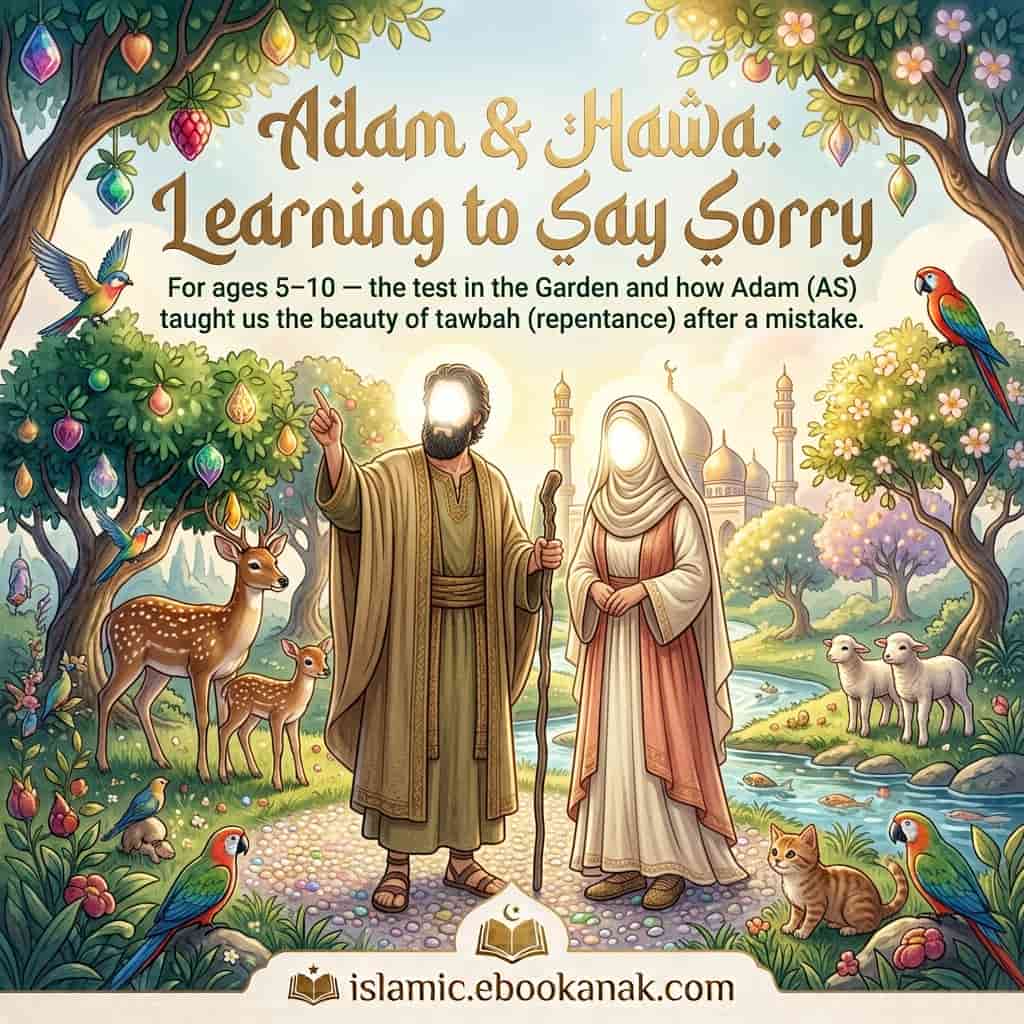
Adam & Hawa: Learning to Say Sorry
What can we learn when we make a mistake?
The story of Adam (AS) and his wife Hawa teaches us something beautiful about mistakes, responsibility, and hope. Their story reminds us that when we turn sincerely to Allah, we can ask for forgiveness and begin again with a better heart.
A Test, a Mistake, and a Beautiful Return
Let’s explore what the Qur’an teaches us about Adam, Hawa, the Garden, and the gift of tawbah.
1. Adam and Hawa in the Garden
Allah placed Adam (AS) and his wife in Jannah (Paradise) and allowed them to enjoy its blessings. They were given a command from Allah: they could eat freely, but they were not to approach a particular tree.
2. A Test of Obedience
Allah’s command gave Adam and Hawa an opportunity to obey Him. The Qur’an teaches that Satan whispered to them and encouraged them toward the tree. They then tasted from it and became aware of their mistake.
3. They Realized Their Mistake
Adam and Hawa recognized what had happened. They did not treat disobedience as something to celebrate or ignore. Instead, they turned toward Allah and acknowledged their need for His forgiveness.
4. Learning Tawbah
Tawbah means sincere repentance: turning back to Allah after doing something wrong. Adam and Hawa asked Allah for forgiveness and showed us that a mistake should lead us toward humility and better choices.
5. Allah Accepted Adam’s Repentance
Allah accepted Adam’s repentance and chose him, guided him, and showed mercy to him. The Qur’an gives us a message of hope: sincerely returning to Allah matters.
Teacher’s Corner: Turn “Sorry” Into Learning
Invite children to complete this sentence: “When I make a mistake, I can ______.” Encourage answers such as “admit it,” “ask Allah for forgiveness,” “say sorry,” “fix what I can,” and “try again.”
Tawbah Flip Cards
Tap a card to reveal the lesson. Tap again to turn it back.
Tawbah means sincere repentance: turning back to Allah after making a mistake or doing something wrong.
They recognized their mistake and turned to Allah, asking Him for forgiveness.
They asked Allah to forgive them and said that if He did not forgive and have mercy on them, they would be among the losers. See Qur’an 7:23.
Yes. The Qur’an tells us that Allah accepted Adam’s repentance and guided him. See Qur’an 2:37 and 20:122.
Admit it, turn to Allah, ask for forgiveness, make things right when possible, and try to choose better next time.
Hope in Allah. A mistake is not a reason to stop trying to do good. We can always turn back to Allah sincerely.
✨ Did You Know?
- The Qur’an teaches that Allah accepted Adam’s repentance and chose him and guided him. See Qur’an 20:122.
- The Qur’an gives Adam and his wife a beautiful prayer asking Allah for forgiveness and mercy. See Qur’an 7:23.
- The Qur’an does not tell us the type of tree in the Garden. We can learn the important lesson without needing to guess its name.
Adam & Hawa: Five Key Moments
A simple visual journey through the main lessons of the story.
The Garden
Allah gave Adam and his wife a home filled with blessings.
The Command
Allah told them not to approach a particular tree.
The Mistake
Satan whispered to them, and they tasted from the tree.
Tawbah
They recognized their mistake and asked Allah for forgiveness.
Guidance
Allah accepted Adam’s repentance and guided him.
Kids Ask, We Answer
Let’s answer some thoughtful questions about Adam, Hawa, and tawbah.
Yes. The Qur’an tells us that they ate from the tree after Allah had commanded them not to approach it. They then recognized their mistake and turned to Allah in repentance.
Tawbah means sincere repentance. It means turning back to Allah, regretting the wrong action, asking Allah for forgiveness, and striving not to return to the same wrong.
Yes. The Qur’an explicitly tells us that Allah accepted Adam’s repentance and guided him. This is one of the hopeful lessons Muslims learn from his story.
Saying sorry can be part of taking responsibility. In Islam, sincere repentance is directed to Allah, and when our mistake has hurt another person, we should also try to make things right with that person.
Making a mistake does not mean you should give up. Islam teaches us to recognize wrong actions, repent sincerely, learn from them, and keep trying to do what is good. Allah’s mercy gives us reason to hope and improve.
🌟 Adam & Hawa Quiz
Choose one answer for each question. The correct answer will be highlighted immediately.
1. Where did Adam and Hawa live before the earthly life described in the Qur’an?
2. What did Allah tell Adam and Hawa not to approach?
3. What does tawbah mean?
4. What did Adam and Hawa do after realizing their mistake?
5. What is one important lesson from Adam’s story?
Keep learning and keep trying!
Saying Sorry Can Be the Beginning of Something Beautiful
Adam and Hawa’s story teaches us that when we make a mistake, we should not hide from Allah or lose hope. We can recognize what went wrong, turn to Allah through tawbah, ask for forgiveness, and try to make better choices.
A sincere “I’m sorry” is not the end of the story. It can be the beginning of repentance, learning, growth, and a better choice.
💭 Think about it: What is one mistake you could learn from and one better choice you could make next time?
🌱 Try This Today: The Tawbah Challenge
Practice the beautiful habit of turning back to Allah. You can do this quietly in your heart or with a parent or teacher.
- 1. Notice: Think of something you did that you wish you had done differently.
- 2. Turn back: Ask Allah sincerely for forgiveness and make a simple intention to do better.
- 3. Make it right: If your mistake hurt someone, say sorry and do something helpful when you can.
- 4. Try again: Choose one good action you can do today. Remember that learning and improving are part of growing.
🤲 Help Keep Islamic Learning Free
Your kind support helps us create joyful and accessible Islamic educational resources for children, teachers, and families.
🤲 Support Free Islamic Learning for Kids